
Identify
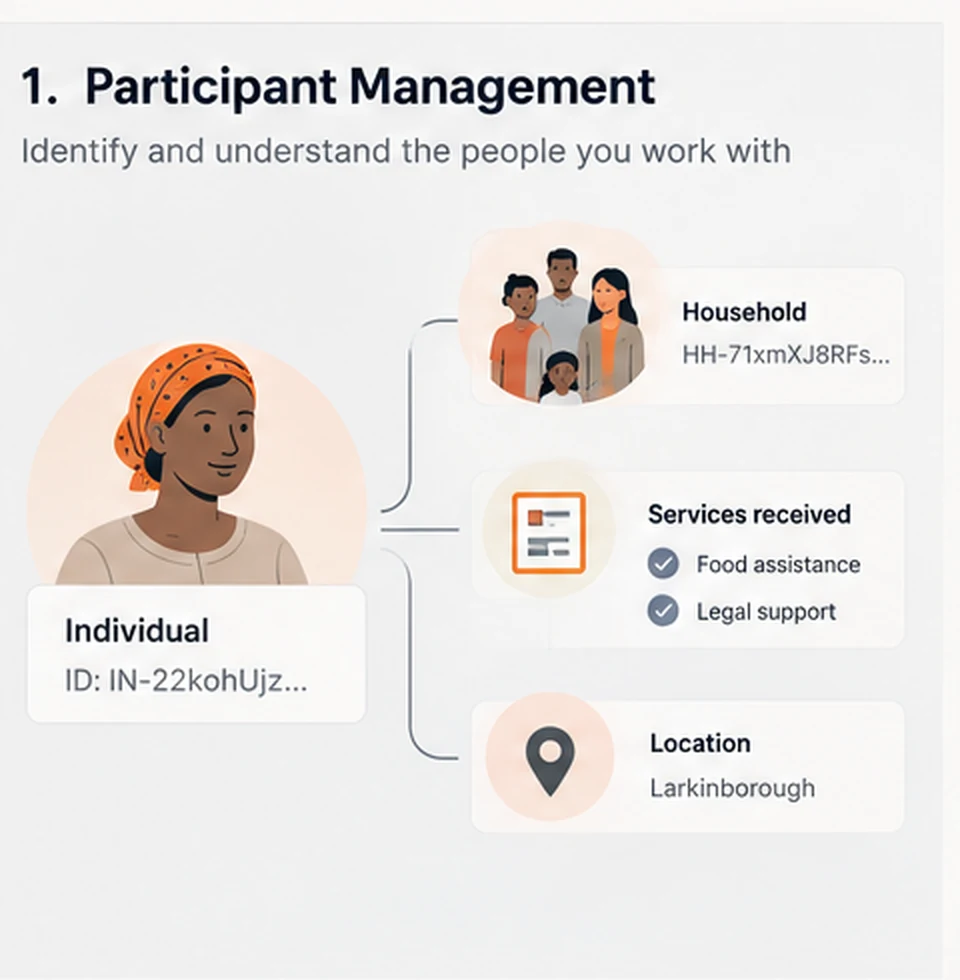
Find an existing participant or register once. Unique IDs, standard fields, entry controls and duplicate detection improve data quality from the start.
CORE / Explore
CORE is designed around programme delivery. Its data model connects the people and entities programmes work with to the activities, locations, teams and implementation records that describe what actually happens.
01 / The operational model
CORE brings participant records, activities, locations and teams into one centralised system. Authorised colleagues share information, see who is responsible and coordinate support across programmes.
Donor, contract, sectors, budget, codes and period.
Outputs, targets, geography, team and target population.
The operational centre of CORE.
WHO — Individual, Household, Collective or Facility · WHAT — Activity · WHERE — Location · BY WHOM — Team · plus implementation-specific information.
02 / Configure once
An Activity is configured once and then instantiated repeatedly as programme delivery takes place. Relevant metadata is inherited; teams add only what is specific to each implementation.
Find an existing participant or register once. Unique IDs, standard fields, entry controls and duplicate detection improve data quality from the start.
Set up the Project and Activity, including outputs, target population, geography and team.
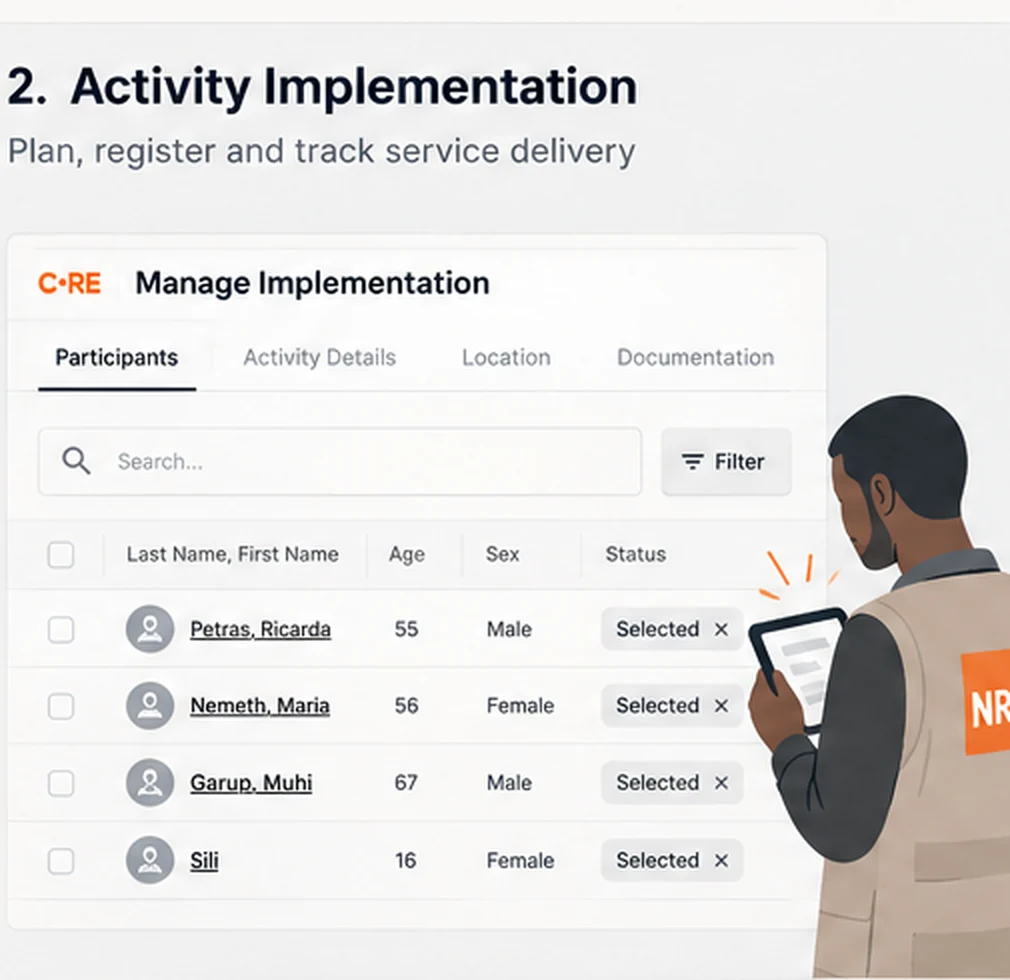
Create Activity Implementations, assign or reassign work between team members and managers, and track actual delivery.
Connect forms, assessments, distributed items, referrals and supporting documents to the relevant operational record.
Share authorised records across teams and sectors. Keep history and references available through handovers instead of re-entering information.
Reuse consistent records and counting rules for cross-programme analysis and automated reporting, with less manual reconciliation and fewer errors.
Actions are logged with timestamps, while participants, Activity Implementations and distributed items remain referenced. Programme, Finance and Supply colleagues can follow the evidence for later audits, subject to access and retention rules.
03 / Explore the building blocks
These modules share records and references. The same structure can support collaboration with local NGOs as part of localisation, with agreed responsibilities and access rights for each partner.

Individuals, households, collectives and facilities.
02Projects, Activities and Activity Implementations.
03Flexible XLSForm-based data collection.
04Connect requests and follow-up to programme context.
05Locations, teams, users, access and reference data.
06Connect field collection, CORE and downstream systems.
Structure once. Share and reuse throughout delivery. Fewer manual steps and less rework mean better data, time saved and more efficient use of programme resources.
Discover the CORE approachExplore field situations, the colleagues involved and the practical benefits.
Explore real-world uses →